FAQs - Quick Links
Whether you're just discovering the breed or you're deep into planning your first flock, these are the questions we're asked most often. If you can't find what you're looking for, email us at info@valaisblacknoseaustralia.com.au — we're always happy to hear from people and chatting about Valais Blacknose Sheep.
Quick links: About the Breed | Planning Your Flock | Find Breeders | Sheep For Sale | eLearning | Join VBA
About the Breed
Where are Valais Blacknose sheep found?
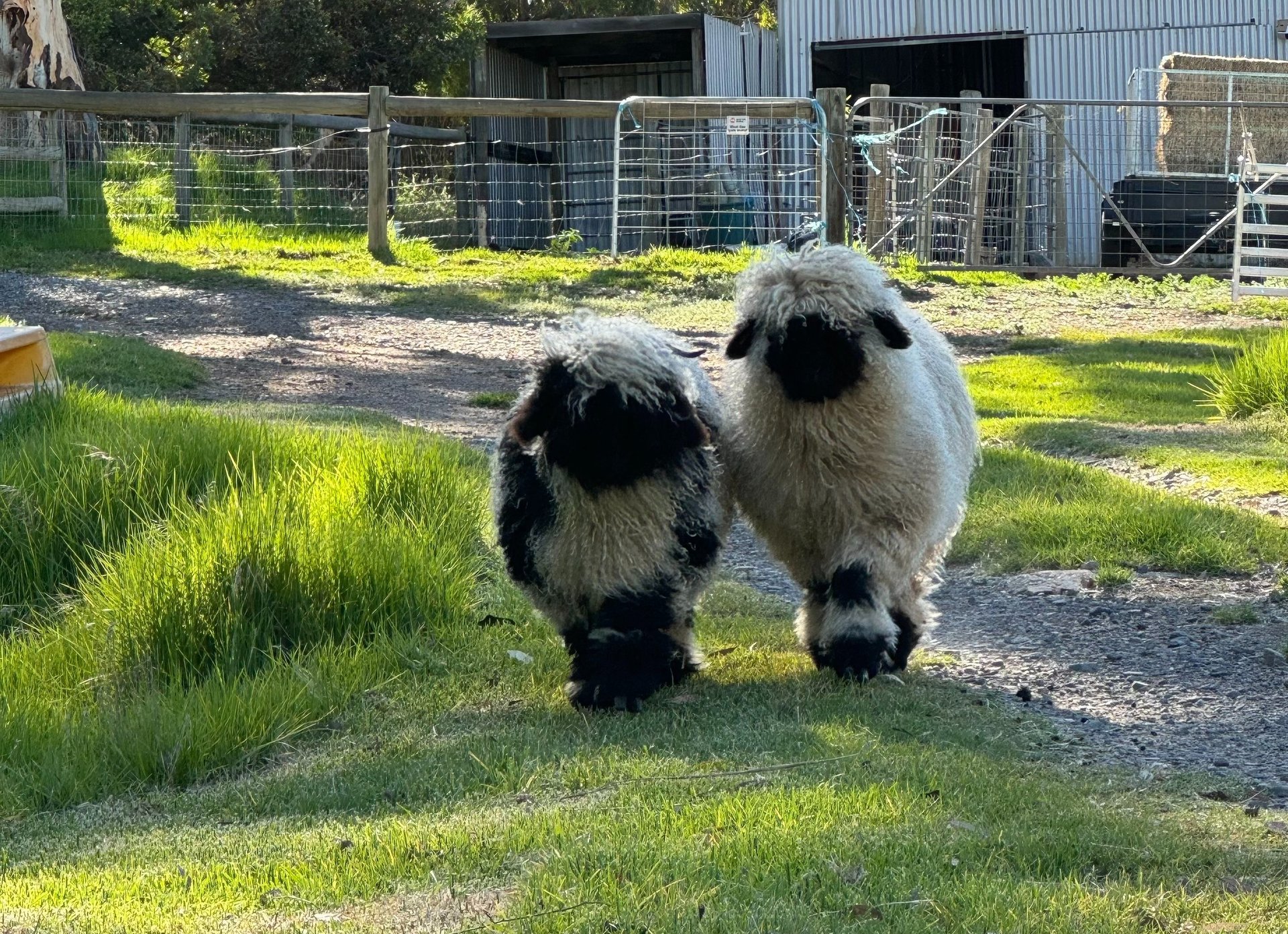
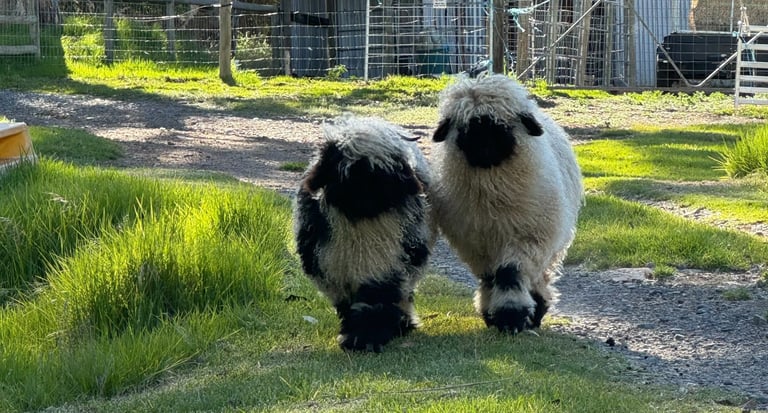
Valais Blacknose originate in the Canton of Valais in the Swiss Alps, where they've been prized since the 1400s. From Switzerland they spread into other European countries, most notably the UK, where their looks and personalities won them a devoted following. The rest of the world has since fallen for them too, with populations now established in New Zealand, the United States, and here in Australia.
→ The full story, including how the breed reached Australia, is on our About the Breed page.
What are their personalities like?
The Swiss have a saying: make friends with a Valais and you have a friend for life. They're curious, calm, and almost entirely unbothered by people — often described as dog-like in their willingness to interact. That makes them genuinely easy to handle. Catching one for routine jobs like hoof trimming usually needs nothing more than a bucket of feed and calling their name. It's a large part of why they suit families, lifestyle farmers and first-time sheep owners as well as they do established studs, and their calm nature also makes them well suited to showing.
→ More on temperament and what makes the breed unique in Australia: Planning Your Flock → Thinking about showing? See the Breed Standard and our Calendar of Events.
What is their fleece like?
Adult fleeces have a broad fibre of around 38 micron. Lamb fleeces are considerably softer, averaging 28–30 micron. The wool is long and coarse, which makes it excellent for felting and well suited to carpets and rugs. Hand spinners often enjoy the staple length, and it blends nicely with other fibres such as alpaca.
→ Fleece quality and coverage are part of how animals are assessed — see the Breed Standard.
Is there a breed standard?
Yes. The standard was set by the original Swiss breed society, and registries around the world, including VBA, have adopted it to maintain the breed in it's original form.
→ Read it in full on the Breed Standard page. If you're buying with showing or breeding in mind, it's your reference point.
→ Ram registration has its own strict criteria. See the VBA Regulations (PDF).
Keeping Valais Blacknose in Australia
Which parts of Australia suit them best?
Valais Blacknose were developed in cool, dry alpine conditions, summered high in the Alps, brought down to lower ground for winter. That's the climate their biology expects. They're now kept successfully across a wide range of Australian climates, but that success depends on the owner. If your property is hot, wet or humid, you can absolutely keep Valais Blacknose, but you'll need to make accommodations for the conditions rather than assume the sheep will adapt on their own. Be cognisant about your climate and stud infrastructure before you buy, and talk to breeders in a similar environment about what works for them.
→ Find Breeders in your state and ask them directly.
→ Shelter, shade and airflow are covered in Infrastructure & Stud Design.
What general care do they need?
Protection from heat is non-negotiable - shade, water and extra attention in hot weather. They also need shearing at least twice a year, sometimes more in very warm and humid regions. Their fleece grows continuously, and this is a real ongoing issue that catches some new owners by surprise. As with any sheep, feet need regular attention, and in wet climates you'll need to stay watchful for foot scald and foot rot. Don't be concerned about these care needs; you just need to plan for them.
→ Sheep Health, Vaccinations, Hoof & Horn Care → Internal & External Parasite Management → Shearing and vaccination costs are broken down on Planning Your Flock.
What do they eat?
In the Alps they graze naturally growing mountain herbs and plants. In Australia they do well on good pasture, supplemented with hay during dry periods and a suitable mineral and salt lick. At times of high nutritional need, such as pregnancy and lactation, high nutritional supplements may assist to keep your sheep healthy and in the best of condition.
Avoid overfeeding grain in preference to fibrous options as it can cause metabolic and digestive problems. A single adult sheep drinks 4–8 litres of water a day, more in hot weather or when lactating.
→ Full feeding and water guidance: Planning Your Flock and many of the eLearning Modules.
How many sheep do I need?
At least two, and preferably three or four. Sheep are flock animals and should never be kept alone. While sheep will bond with some other animals (humans included), no other animal is a substitute for a 24/7 sheep friend. A common and sensible approach is to pair higher-value animals with a Breed Up wether as a companion. Wethers are far more affordable, and many owners will tell you they're the most people-focused and affectionate sheep on the place.
→ Browse companion wethers on Breed Up Sheep For Sale.
What infrastructure do I need before my sheep arrive?
Secure fencing, a well-ventilated shelter, clean water, basic yards and a catch pen, and genuine predator protection — foxes and wild dogs are the main threats in most areas.
→ Get this right first: Infrastructure & Stud Design → And before new animals arrive: Biosecurity on a Stud
Buying Valais Blacknose Sheep
How much do Valais Blacknose sheep cost?
Prices vary enormously depending on percentage, markings, bloodlines and overall quality. Breeders set their own prices, but as a guide:
Purebred
Wethers from $3,000
Breeding ewes from $18,000
Breeding rams from $18,000
Breed Up
F1 wethers from $500
F1 ewes from $3,000
F4 and F5 animals move towards purebred pricing
Wethers and non-breeding animals sit well below breeding stock, which is why they make such good companions if you're only buying a few.
→ Full cost planning, including feed, shearing, vaccinations, and fencing, is on Planning Your Flock.
→ Given these values, deal only with registered breeders. Our For Sale & Buying guide covers scam avoidance and exactly what to ask.
What's the difference between Purebred and Breed Up Valais?
There are two separate registration pathways, with different costs, genetics and long-term outcomes.
Purebred — full Valais Blacknose parentage on both sides, DNA verified. White registration certificates.
Breed Up — produced by crossing a Valais Blacknose ram over ewes of any wool breed, then lifting the Valais percentage each generation. Pink certificates.
Australian Breed Up Pure (A Class) — animals that reach F5 (96.88% or above). Considered equivalent to purebred for showing but cannot be classed as purebred for any matters, e.g. they are registered on the Breed Up Registry and can not be deemed spitti. Blue certificates.
→ Pure Breeding Program → Breed Up Program → Side-by-side comparison and flowchart: Planning Your Flock
How do I find sheep or genetics for sale?
Animals and genetics offered by VBA members are listed here:
→ Pure Sheep For Sale → Breed Up Sheep For Sale → Genetics For Sale (semen and embryos) → Or browse breeders state by state on Find Breeders.
You can also meet breeders and sheep in person at shows and member events — see the Calendar of Events.
What should I ask a breeder before I buy?
At minimum: is the animal registered with VBA and can progeny be registered, can you see the certificate, has DNA been verified, is there a current NLIS tag, what vaccinations has it had, and how is Johne's disease managed on that stud? Use VBA resources to assist you to ask the extensive list of questions required before taking on a new animal.
→ The full list of questions, covering health history, breeding history, pregnant ewes, ram semen rights, transport guarantees and insurance, is in our For Sale & Buying guide.
→ Verify your seller is a current member on Find Breeders.
Where does Australian stock come from?
Australia's foundation genetics arrived from the UK as frozen semen and embryos, imported under strict Australian government rules. Since then, a number of breeders have brought in additional genetics from the UK, steadily widening the national gene pool.
→ The full history: About the Breed
Registration & DNA
Why do my lambs have to be DNA tested?
Because a pedigree is only worth what it can be proven to be! Parent verification allows the registry to only recording the true, verified pedigree of every animal kept on the flock book. You can trust be assured that our members are required to provide accurate information and a DNA sample to confirm a new sheep's genetic line. It means buyers can feel comfortable that the sheep they're paying for, is the sheep they're getting. A fully DNA-verified registry was the founding principle of VBA and remains a cornerstone of what we're building. Appearance alone tells you nothing reliable about percentage; only DNA can.
→ Pure Breeding Program | Breed Up Program
How do I get my lambs DNA tested?
Once you're a VBA member you'll have the ability to register your lambs. Our information will walk you through the process step by step, along with the forms you'll need. If members need one-on-one help, we are here to support members.
→ Member Resources → Not a member yet? Join VBA
Note that DNA verification and parentage confirmation can take up to three months, which matters if you're buying young lambs whose registration is still in progress. Discuss with the breeder what guarantees are offered for future registration and parentage should verification not be possible.
What does a VBA registration certificate tell me?
It confirms the animal's identity, its parentage and DNA status, and its registration level. Always request the original or a trustworthy copy before purchase.
→ How to read one, and how to handle registrations still in progress: Planning Your Flock and For Sale & Buying. Contact VBA at info@valaisblacknoseaustralia.com.au if you require any assistance to understand or utilise registration certificates.
What is the Breed Up program?
It allows members to work towards Australian Breed Up Pure Valais Blacknose sheep, starting with foundation ewes of any breed and using pure Valais Blacknose semen, lifting the percentage each generation. It's a more accessible entry point than buying purebreds outright, and a legitimate long-term breeding pathway in its own right, particularly if you already own suitable foundation ewes.
→ Full detail on percentages, generations and ram rules: Breed Up Program
Can I register sheep bred from genetics imported from overseas?
Yes. VBA accepts applications to register animals descended from genetics imported from other recognised registries, provided all relevant importation documentation is supplied for verification. These animals all require DNA verification to be added to VBA's Register.
→ Get in touch before you commit to an import, or see Member Resources.
Do ram lambs that don't meet the breed standard have to be castrated?
Yes, and it matters for the future of the breed here! Only the best males should be kept entire, so ram lambs that fall short on appearance, conformation or fleece should be castrated.
Castrated males can be registered as wethers in the Registry and issued with a Breed Up or Purebred certificate (as appropriate). In the Breed Up program, all ram lambs in the first four generations are castrated and sold as pets.
→ Breed Standard | VBA Regulations (PDF)
How long do I have to castrate a ram lamb?
Best practice animal welfare standards encourages use of local anaesthetic and analgesia when marking lambs. Tail Docking and Castration of lambs should be done as early as possible, and is recommended to be completed by 12 weeks of age as per the Australian Veterinary Association. Once a lamb reaches three months, castration must be carried out by a vet under general anaesthetic.
→ Sheep Health, Vaccinations, Hoof & Horn Care | Lambing: Preparation, Birth & Early Care
Which rams can I use?
VBA has specific rules about for the utilisation of rams for breeding within the Breed Up and Purebred programs. Please always ensure a ram is registered and continues to meet breed standard; if you are unsure, please contact VBA. If a ram is not eligible to breed, resulting lambs will not be registrable at the level you intended. Please check before you join your ewes, not after.
Australian Regulations
What is a PIC number?
If you intend to keep livestock you must have a Property Identification Code. It identifies your property and the animals on it, and it's what government agencies rely on in a biosecurity emergency. The application process differs by state so please check your state's Department of Agriculture website. Both buyer and seller need a PIC before sheep change hands; sellers also need to be LPA accredited.
→ Sheep Regulations & Compliance
What is NLIS / EID sheep identification?
The National Livestock Identification System records livestock movement across Australia using NLIS-approved ear tags, and all states are moving toward full Electronic Identification (eID). Every sheep sold in Australia must carry a current NLIS tag - it's a legal requirement for movement. The tag number is also what identifies the animal on its pedigree papers, so the tag and the paperwork must match. Confirm this before completing any purchase.
→ Sheep Regulations & Compliance → For Sale & Buying
What paperwork do I need to move sheep?
A National Vendor Declaration (NVD) and NLIS transfer records need to be sorted before animals travel. Non-compliance may have major ramifications for your property and stud, as well as your VBA membership. If you are needing general advice for completion of these documents, members are welcome to contact VBA for assistance; more specific help can be sought from the compliance and regulation authorities.
→ Sheep Regulations & Compliance → Transport, quarantine and settling-in advice: Planning Your Flock
Do I need to quarantine new sheep?
Yes. Quarantine new arrivals separately from any existing flock for a minimum of 21 days, and run a Faecal Egg Count, treating for internal parasites as indicated, before integrating them. Additional testing may be completed so please discuss new arrivals with your livestock veterinarian.
Be aware that a quarantine period will not reveal everything which is why ongoing vigilance across your whole flock matters.
→ Biosecurity on a Stud → Internal & External Parasite Management
Learning & Membership
Where can I learn more before I buy?
We'd encourage anyone preparing to bring Valais Blacknose home to work through our eLearning modules first, and to have a mentor in place. VBA can assist to link you with other members if you don't have a mentor.
→ eLearning Program — covering:
Is there anything for kids?
Yes — we have a growing space for young Valais Blacknose enthusiasts getting started with sheep.
VBA has exciting updates coming regarding how we will encourage the next generation of sheep enthusiasts!
Why should I join VBA?
Membership connects you to a community of Valais Blacknose breeders across Australia offering support, education and networking as you find your feet with the breed or to allow you to share your extensive experience.
As a member you can be verified as a breeder and list your stud on our website, advertise sheep and genetics for sale, access information on Australia's largest DNA database/Registry, and register your animals on our fully DNA-verified registry, maintained on the Grassroots platform. You'll also get access to our members-only Facebook group and zoom forums for education and support.
→ About VBA — who we are
→ Join VBA — apply
→ Member Resources
→ Grassroots registry login (existing members)
How do I become a member?
→ Apply on the Join VBA page, or email info@valaisblacknoseaustralia.com.au if you'd like to talk it through first.
Can I buy VBA merchandise?
→ Shop - our shop is coming soon!
Still have a question?
There's no such thing as a silly question when you're starting out. Email info@valaisblacknoseaustralia.com.au and we'll point you in the right direction - or come and find us on Facebook, Instagram and TikTok.
Ready to take the next step? Plan your flock | Find a breeder | Join VBA
EMAIL info@valaisblacknoseaustralia.com.au
© 2026. VBA Ltd. All rights reserved.
Facebook Groups