
Valais Blacknose Breed Standard
The Valais Blacknose breed standard was established by the original Swiss breed society, the Oberwalliser Schwarznasen Schafzuchtverband (Upper Valais Blacknose Sheep Breeding Association), and has been adopted by registries around the world. It sets out the requirements for a correctly marked and well-conformed Valais Blacknose Sheep across three areas: general appearance, including all black markings; conformation, covering body structure, limbs, and gait; and wool, including fleece quality, staple length, and the absence of undesirable fibre types.
Conformation
Limbs
Strong, well placed, and well woolled
Solid strong hooves
Straight legs – not bow legged, not knock-kneed/cow-hocked
Slight hock angulation
Short strong pasterns
Solid bone structure
Joints straight and sound
Gait
Spacious, surefooted, straight and wide-legged
Doesn’t sway or waver
Even and stable movement
Mobile with ease
Wool/Fleece
Fleece in lambs is soft to the touch and becomes coarser as the sheep matures
The Swiss measurement for fineness of 5-4 equates to approximately 28-38 micron depending on age and gender with finest wool in lambs and coarsest wool in adult males
Staple length is 10cm based on 6 months growth and is the minimum length required for showing
Fleece is uniformly white and evenly distributed over the whole body including head and legs
In females, only some black hairs are tolerated on the neck area; in males up to 18 months of age this is a reason for exclusion/castration
Fleece weight when shorn
Lambs 1-1.5kg
Ewes and rams 2.5-3kg- based on twice yearly shearing with 6 months growth
Breed Standard
General Appearance
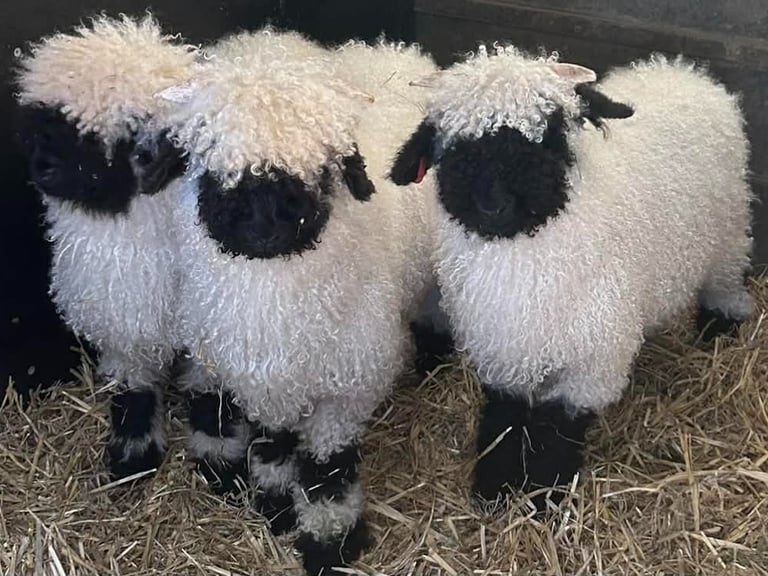
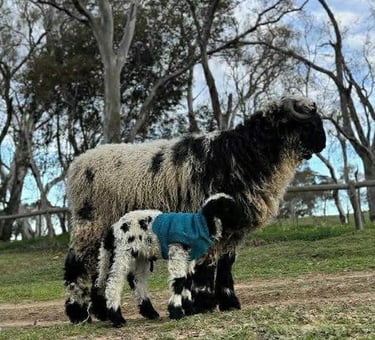
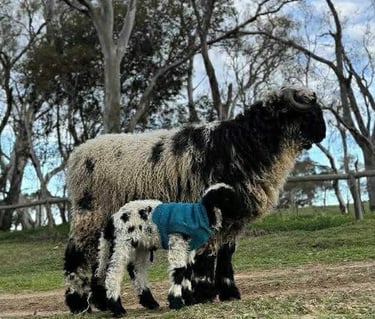
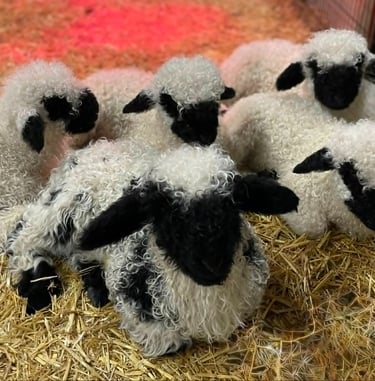
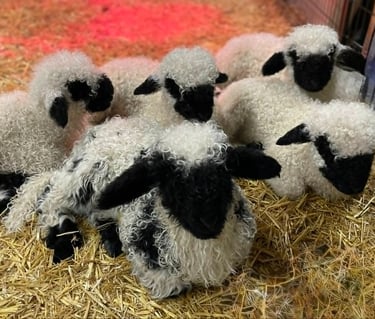
Black nose to centre of the head
Black encompassing the eye area connecting with the black of the nose, no gap is permitted
Black ears – black should meet the white of the head- a gap of white between ears and face is required
Black hooves and ankle area, i.e. black socks
Black spots on knees and hocks – they can be non-symmetrical and can be very small
Females:
Females should have a black tail spot. This spot should be interrupted with a finger width of white on the tail
Females missing a marking feature (ie a knee spot) may have a point deduction depending on overall conformation and wool
Males:
Males must not have a tail spot
Scrotum may be black but the black must not extend upward into the main fleece, i.e. black must be contained to the belly area
A black patch around the umbilical cord location is acceptable for males and females
Other colour patterns are mismarked
Head and Neck
Short, compact, well-proportioned head, with medium length ears
Wide mouth, broad forehead, Roman (convex) nose
Pronounced, regal head shape in in rams; mature rams often develop protuberances behind horn base
Short, straight, well-muscled neck
Horns – males and females
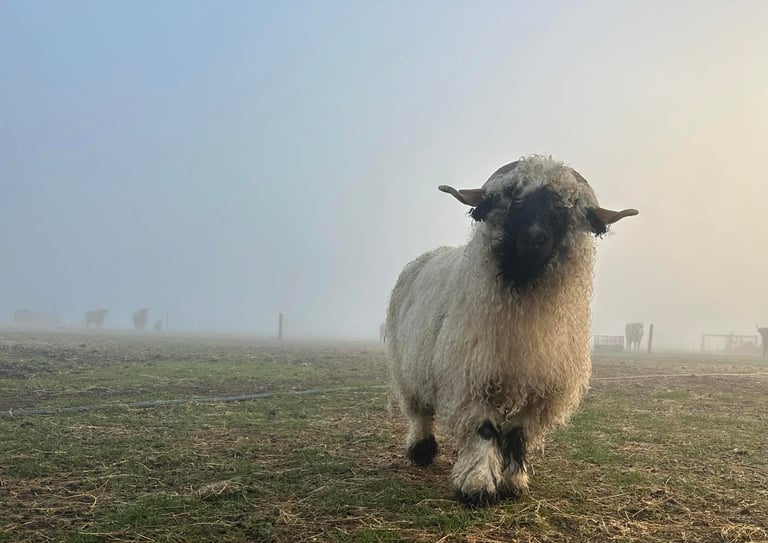
Spiral outward from head, horizontally. Well set off from cheeks (you should always be able to fit a flat hand comfortably between the horn and the cheek
Black stripes in the horns are acceptable
Chest, Shoulder and Withers
Broad, deep chest
Shoulders line naturally with neck and chest
Well-spaced, broad withers
Rib curvature is well proportioned and rounded
Back and Loin
Long, straight top line
Wide back and well-muscled loin
Pelvis, abdomen and hindquarters
Medium sized belly with small belly hollows (paralumbar fossa)
Wide and medium length pelvis
Well-muscled hindquarters
Height at wither (over two years)
Female 72-78 cm
Male 75-83 cm
Weight (over 2 years)
Female 70-90 kg
Male 80-120 kg
Undesirable Traits: Reason for Castration and Exclusion of Rams
In addition to not meeting the Breed Standard elements listed above, the following traits are reasons to castrate a ram lamb or for a ram to be refused registration:
Undesirable Anatomy
· Uneven jaw length – undershot/overshot, incisor teeth not in contact or correct position relative to dental pad
· Weak and or fallen pasterns
· Stunted growth/small in stature
· Undescended or missing testicle(s)
· Scrotal hernia
Undesirable Markings
· Black spots on body – above the belly line, especially in males
· Black tail spots (in rams)
· Markings missing from knees, hocks or head
Undesirable Wool
· Major flaw in the wool examples below
· Kemp fibres - short Medullated (hollow) fibres with pointed tips. These fibres are coarse, brittle, weak and prickly and do not take up dye
· Tender fibres - break easily and may occur due to malnutrition, disease or scarring
· Excessive number of guard hairs – long, coarse, stiff, outer coat hair
· Mixed coloured wool in rams under 18 months of age
The Spitti
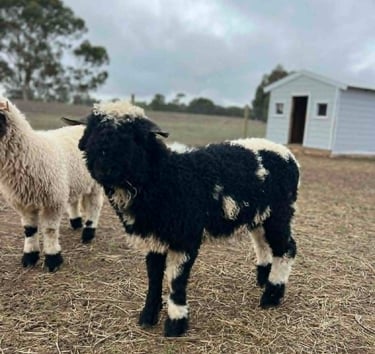
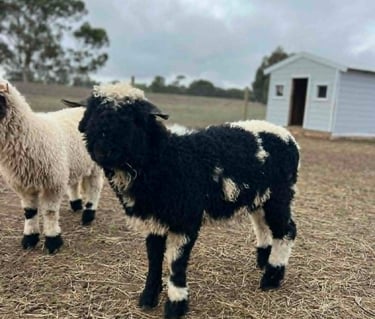
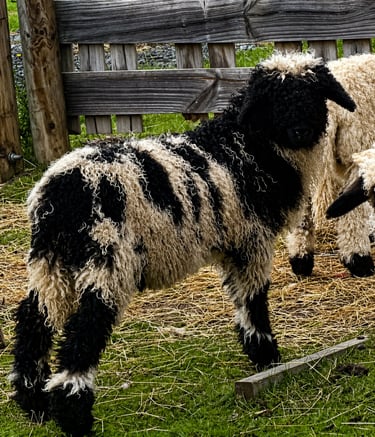
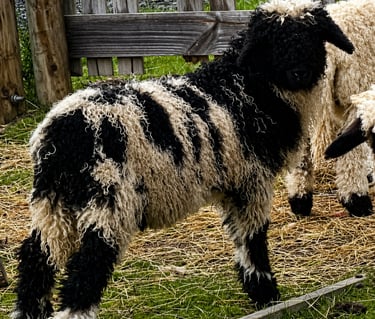
Occasionally purebred Valais Blacknose (i.e. from purebred parentage on the dam and sire lines) may produce offspring that are marked with additional black or even in reverse pattern - this is referred to as ‘Spitti’. Spitti colouring is a genetic trait however the genes have not been identified. In some places around the world, spittis are considered good luck but it is important to remember, they are officially mismarked.
Spitti Valais Blacknose sheep have the following accepted principles:
A Spitti can only occur where both the sire and dam are purebred Valais Blacknose. Spitti animals do not exist within the Breed Up Program, as it is not possible to determine whether an atypical marking pattern is the result of the true Spitti gene or the influence of the foundation ewe's genetics.
Some spittis have predominantly black wool instead of white, while others may have a splotching pattern.
Sheep with common mismarks, e.g. extra black leg spots or a single colour spot, are not considered to be spitti.
Spitti rams must be castrated and are not eligible for registration for breeding purposes as per the original Upper Valais Blacknose Sheep Breeding Association.
Spitti ewes are eligible for breeding and registration.
EMAIL info@valaisblacknoseaustralia.com.au
© 2026. VBA Ltd. All rights reserved.


Facebook Groups